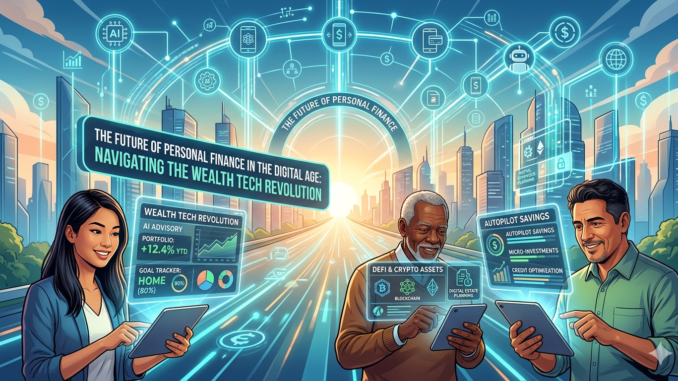
The concept of money is undergoing its most radical transformation since the invention of paper currency. For centuries, personal finance was a tedious, analog affair characterized by physical ledgers, monthly paper statements, and long lines at brick-and-mortar banks. Managing wealth required deep financial literacy, significant time, or the capital to hire a professional advisor.
Today, we are standing on the precipice of a new era. The convergence of smartphone ubiquity, artificial intelligence (AI), blockchain technology, and decentralized networks has democratized, automated, and hyper-personalized the way we earn, save, invest, and spend. The future of personal finance in the digital age is not merely about moving physical cash into a digital wallet; it is about a fundamental shift in economic agency, where technology empowers the individual to achieve financial autonomy like never before.
1. The Demise of the Traditional Bank and the Rise of Neo-Banking
The traditional banking model—reliant on physical branches and rigid, legacy infrastructure—is rapidly becoming obsolete. In its place, Neo-banks (or digital-only banks) have emerged, entirely unburdened by the overhead costs of physical real estate.
[Traditional Banking] ----> Legacy Systems, Paperwork, Physical Branches
                                   VS.
[Neo-Banking]        ----> Cloud-Native, API-Driven, Instant & Borderless
Seamless User Experiences
Neo-banks prioritize user experience above all else. Accounts can be opened in minutes via a smartphone app, featuring real-time transaction notifications, instant peer-to-peer transfers, and sophisticated built-in budgeting tools. By leveraging data analytics, these platforms categorize spending habits automatically, giving users an immediate, visual understanding of where their money goes.
Borderless and Frictionless Transactions
In a globalized digital economy, traditional international wire transfers—notorious for high fees and days-long processing times—are being replaced by frictionless, multi-currency digital accounts. Digital banking platforms allow users to hold, convert, and spend dozens of currencies at the interbank exchange rate, effectively erasing geographic borders for personal commerce.
2. Artificial Intelligence and Hyper-Personalized Wealth Management
Perhaps the most disruptive force in digital personal finance is Artificial Intelligence. Historically, wealth management was an elite service reserved for the high-net-worth individual. AI has democratized this sector through Robo-advisors and Autonomous Finance.
The Democratization of Investing
Robo-advisors utilize sophisticated algorithms to build and manage a diversified portfolio based on an individual’s risk tolerance, financial goals, and time horizon. By automating asset allocation and tax-loss harvesting, these platforms operate at a fraction of the cost of a human financial advisor, making wealth creation accessible to anyone with a few dollars to spare.
+-------------------------------------------------------------+
|               The Autonomous Finance Flywheel               |
+-------------------------------------------------------------+
|  [Data Ingestion]  --> Analyzes earnings & spending patterns |
|         |                                                   |
|         v                                                   |
|  [AI Optimization] --> Identifies surplus capital           |
|         |                                                   |
|         v                                                   |
|  [Auto-Investment] --> Deploys funds into optimized assets  |
+-------------------------------------------------------------+
The Shift to Autonomous Finance
We are moving from a “do-it-yourself” digital finance model to a “do-it-for-me” era. Autonomous finance refers to software that takes over day-to-day financial decision-making. Imagine an AI assistant that monitors your checking account, predicts upcoming bills using historical data, detects a surplus, and automatically routes that extra cash into a high-yield savings account or an index fund. It optimizes your financial health in the background of your life, mitigating the psychological biases and inertia that often lead to poor financial habits.
3. Decentralized Finance (DeFi) and Tokenization
While fintech has optimized the front-end user experience, the back-end infrastructure of global finance is being challenged by Decentralized Finance (DeFi) and blockchain technology. DeFi replaces centralized intermediaries—like banks and brokerages—with self-executing smart contracts on a blockchain.
Yield Generation and Global Liquidity
DeFi protocols allow individuals to lend, borrow, and trade digital assets globally without a middleman. For the everyday user, this opens up alternative avenues for yield generation that far outpace the negligible interest rates offered by traditional savings accounts. Through stablecoins (cryptocurrencies pegged to fiat currencies like the US dollar), users can participate in global lending pools, earning yields directly from the borrowers.
Tokenization of Real-World Assets (RWAs)
The digital age is unlocking fractional ownership of historically illiquid and high-barrier assets. Through tokenization, a multi-million-dollar commercial real estate property, a rare piece of fine art, or a basket of government bonds can be divided into digital tokens on a blockchain.
Example: A retail investor can buy a $10 token representing a fractional share of an apartment building in New York, receiving a proportionate share of the rental income directly to their digital wallet. This radically levels the playing field for wealth accumulation.
4. The Evolving Landscape of Payments and Credit
The way we pay for goods and services, as well as how we access leverage, is undergoing an irreversible evolution. Cash is rapidly disappearing, replaced by contactless, embedded, and alternative credit mechanisms.
Central Bank Digital Currencies (CBDCs) and Stablecoins
Governments and central banks worldwide are developing Central Bank Digital Currencies (CBDCs). Unlike decentralized cryptocurrencies, CBDCs are digital representations of a country’s sovereign fiat currency, backed by the central bank. Alongside regulated private stablecoins, CBDCs will make payments instantaneous, secure, and highly programmable. Programmable money means funds could be coded to be spent only on specific necessities (such as insurance or education) or automated to pay micro-taxes at the exact moment of a transaction.
Alternative Credit and Genomic Scoring
The traditional credit scoring system (e.g., FICO) is inherently exclusionary, relying on legacy data that often leaves young people, immigrants, and the unbanked out of the financial system. The digital age leverages alternative data points to assess creditworthiness. By analyzing a user’s utility payment history, e-commerce transaction frequency, and even cash-flow consistency via open banking APIs, financial institutions can grant credit safely to a broader demographic.
Furthermore, Buy Now, Pay Later (BNPL) models have shifted credit directly to the point of sale, seamlessly embedding financing options into the everyday consumer journey.
5. Challenges, Risks, and the Dark Side of Digital Finance
While the future of personal finance promises unprecedented convenience and democratization, it also introduces a complex matrix of systemic and individual risks that cannot be ignored.
       CHALLENGES IN DIGITAL FINANCE
┌───────────────────┬───────────────────┐
│ Cyber Security &  │ Financial Algos & │
│ Phishing Attacks  │ Cognitive Biases  │
├───────────────────┼───────────────────┤
│ Data Privacy &    │ The Digital       │
│ Monetization      │ Literacy Divide   │
└───────────────────┴───────────────────┘
- Cybersecurity and Digital Fraud: As financial assets migrate into the digital ether, they become targets for highly sophisticated cybercriminals. Phishing, ransomware, smart contract exploits, and identity theft are rampant. In a decentralized or automated financial ecosystem, a single lost private key or compromised password can result in the permanent, irreversible loss of life savings.
- The Gamification of Investing: The democratization of trading platforms has often led to the “gamification” of personal finance. User interfaces designed with celebratory confetti, push notifications, and social feeds encourage frequent, speculative short-term trading rather than disciplined, long-term investing. This environment can exacerbate cognitive biases, leading retail investors to chase volatile hype cycles and incur devastating losses.
- Data Privacy and Surveillance: In the digital age, your financial data is highly valuable. FinTech platforms gather intimate details about where you go, what you eat, your entertainment preferences, and your future plans. The risk of this data being weaponized for predatory lending, sold to third-party advertisers, or monitored by authoritarian states via CBDCs poses a significant threat to individual privacy and civil liberties.
- The Digital Literacy Divide: Technology can only democratize finance if individuals understand how to use it. The rapid pace of innovation risks widening the wealth gap between those who are tech-savvy and financially literate, and those who are left behind by the digital transition due to age, lack of internet access, or systemic exclusion.
6. Framework for Success: Managing Wealth in the New Era
To thrive in this hyper-connected, fast-paced financial ecosystem, individuals must adopt a proactive strategy rooted in both technological adaptability and timeless financial principles.
Dynamic Financial Literacy
Financial literacy is no longer just about understanding compound interest and balancing a checkbook. It now requires a foundational understanding of data security, digital asset custody, algorithmic risk, and platform privacy settings. Knowing how to secure accounts with multi-factor authentication (MFA) and recognizing algorithmic nudges is just as critical as choosing the right mutual fund.
Embracing Hybrid Models
While automation and AI offer immense efficiency, the human element remains vital for complex financial planning—such as estate planning, intricate tax strategies, or navigating major life transitions like divorce or retirement. The most resilient personal finance strategy is a hybrid one: utilizing AI for daily optimization, micro-investing, and budgeting, while consulting human professionals for macro-level strategy and emotional sanity checks during market crises.
Conclusion: The Sovereign Financial Individual
The future of personal finance in the digital age is ultimately a story of empowerment. By dismantling the barriers of cost, geography, and complexity, technology has handed the keys of financial sovereignty back to the individual.
We are no longer passive consumers of rigid financial products dictating our economic lives; instead, we are the architects of our own customized, automated, and global financial ecosystems. Those who approach this digital frontier with a healthy blend of technological optimism and rigorous risk management will find themselves uniquely equipped to build sustainable, generational wealth in the 21st century. The digital age does not merely change how we handle money—it fundamentally redefines what it means to be financially free.
Leave a Reply