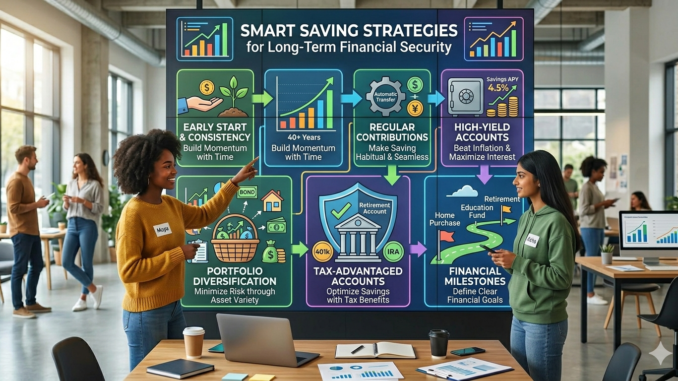

In an era of economic unpredictability, fluctuating inflation rates, and evolving job markets, achieving financial independence is no longer just a luxury—it is a necessity. True financial security does not come from how much money you earn, but rather from how much you keep and how wisely you manage it. Building a robust financial cushion requires intention, discipline, and strategic planning.
The following comprehensive strategies are designed to help you transform your saving habits and build an unshakable foundation for your long-term financial future.
1. Shift Your Mindset: Pay Yourself First
Most people approach saving with a flawed formula:
$$\text{Income} – \text{Expenses} = \text{Savings}$$
The danger of this method is that human nature tends to expand expenses to meet available income. By the end of the month, there is often little to nothing left to save.
To achieve long-term security, you must flip the equation:
$$\text{Income} – \text{Savings} = \text{Expenses}$$
This is the principle of paying yourself first. Treat your savings goal as a non-negotiable monthly bill. The moment your paycheck arrives, automatically route a predetermined percentage (ideally 15% to 20%) into a separate savings or investment account before you buy groceries, pay rent, or spend on entertainment.
2. Leverage the Power of Automation
The greatest enemy of consistency is human friction. If you have to manually transfer money to your savings account every month, you open the door to temptation, procrastination, and decision fatigue.
The easiest way to bypass this is automation.
- Automatic Transfers: Set up a recurring transfer from your checking account to your savings or investment accounts on the day after payday.
- Direct Deposit Split: Ask your employer’s payroll department to split your direct deposit, sending a portion directly to a high-yield savings account.
By making saving invisible and effortless, you build wealth in the background while adapting your lifestyle to the remaining income.
3. Build a Tiered Emergency Fund
Life is full of unexpected curveballs—medical emergencies, sudden job loss, or major car repairs. Without an emergency fund, you risk falling into high-interest debt that can derail your financial goals for years.
A smart saving strategy involves creating a tiered emergency fund:
- Tier 1 (Immediate Liquid Cash): Keep 1 to 2 months’ worth of living expenses in a standard checking or basic savings account for immediate access.
- Tier 2 (High-Yield Savings): Keep an additional 3 to 6 months’ worth of expenses in a High-Yield Savings Account (HYSA). These accounts offer significantly higher interest rates than traditional brick-and-mortar banks, allowing your money to combat inflation while remaining completely safe and accessible.
4. Master the Art of Intentional Budgeting
You cannot save effectively if you do not know where your money is going. Budgeting isn’t about restricting your joy; it is about giving your money a specific purpose.
A popular and highly effective framework is the 50/30/20 Rule:
| Allocation | Category | Examples |
| 50% | Needs | Rent/Mortgage, Utilities, Groceries, Insurance |
| 30% | Wants | Dining out, Hobbies, Travel, Streaming services |
| 20% | Savings & Debt | Retirement, Emergency fund, Extra debt payments |
Track your expenses for at least 30 days using an app, a spreadsheet, or a notebook. Identify “money leaks”—such as unused subscriptions, daily premium coffees, or impulsive online shopping—and redirect those funds toward your 20% savings goal.
5. Attack and Eliminate High-Interest Debt
It is nearly impossible to build long-term wealth if you are bleeding money to high-interest debt, such as credit card balances or high-rate personal loans. If you are paying 15% to 25% interest on a credit card, any money you put into a savings account earning 4% is actually losing you money in the grand scheme.
Use one of these two proven methods to clear your debt:
- The Debt Avalanche: List your debts from highest interest rate to lowest. Pay the minimums on all, and throw every extra dollar at the highest interest debt. This saves you the most money mathematically.
- The Debt Snowball: List your debts from smallest balance to largest. Pay off the smallest debt first for a quick psychological win, then roll that payment into the next smallest.
6. Invest for Long-Term Growth (Beat Inflation)
Simply leaving all your money in a traditional bank account is actually a losing strategy over time. Due to inflation, the purchasing power of your cash decreases every year. To secure your future, a portion of your savings must be invested to grow.
“Do not save what is left after spending, but spend what is left after saving.” — Warren Buffett
Harness the Power of Compound Interest
The earlier you start investing, the harder your money works for you. Compound interest is the process where your earnings earn earnings.
For example, if you invest $300 a month with an average 8% annual return, look at how time dramatically scales your wealth:
- After 10 years: ~$54,000
- After 20 years: ~$177,000
- After 30 years: ~$440,000
Diversify Your Portfolio
Don’t put all your eggs in one basket. Divide your investments across low-cost Index Funds, Exchange-Traded Funds (ETFs), bonds, and retirement accounts (like a 401k or IRA). This protects your wealth from market volatility while ensuring steady, long-term growth.
7. Adopt the “Lifestyle Creep” Defense
As your career progresses, your income will likely increase. Lifestyle creep occurs when your standard of living rises right along with your income. You get a raise, so you buy a nicer car, move into a more expensive apartment, and suddenly, you are still living paycheck to paycheck despite making more money.
To counter this, practice Save-Rate Scaling:
When you receive a salary raise or a bonus, immediately allocate 50% of the increase directly to your savings and investments. You can use the other 50% to improve your current lifestyle. This allows you to celebrate your professional success while simultaneously accelerating your journey to financial security.
Conclusion
Long-term financial security is not the result of a single brilliant financial move or a stroke of luck. It is the cumulative effect of small, disciplined, daily choices. By automating your savings, protecting yourself with an emergency fund, budgeting intentionally, and allowing your money to grow through strategic investments, you take total control of your future.
The best time to start practicing these strategies was ten years ago. The second best time is today. Small steps taken right now will yield massive financial freedom tomorrow.
Leave a Reply