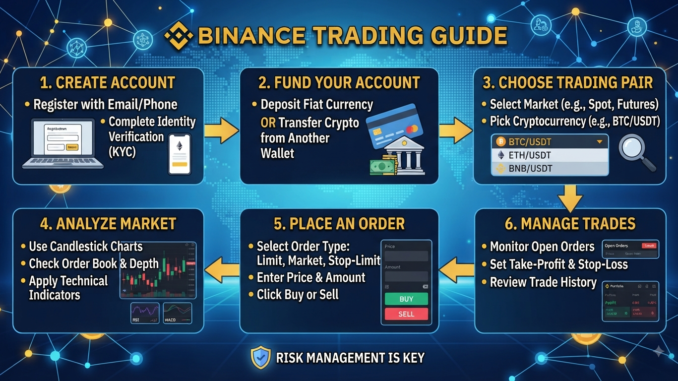
Cryptocurrency trading has transformed from a niche internet phenomenon into a global financial powerhouse. At the epicenter of this digital revolution is Binance, the world’s leading cryptocurrency exchange by trading volume and liquidity. Whether you are stepping into the crypto market for the very first time or you are an experienced trader looking to refine your execution, mastering the Binance ecosystem is essential for navigating the fast-paced world of digital assets.
This comprehensive guide is designed to take you through the foundational concepts, advanced mechanics, risk management frameworks, and strategic methodologies needed to trade effectively on Binance.
Section 1: Understanding the Binance Ecosystem
Before placing your first trade, it is crucial to understand how Binance functions and the vast array of financial tools it provides to its users. Launched in 2017, Binance has evolved far beyond a simple spot exchange into a comprehensive blockchain ecosystem.
1.1 Account Setup and Security
Your trading journey begins with account creation and, most importantly, security. Cryptocurrency transactions are irreversible, making your account a prime target for malicious actors.
- Two-Factor Authentication (2FA): Always link Google Authenticator or passkeys rather than relying solely on SMS, which can be vulnerable to SIM-swapping.
- Identity Verification (KYC): Binance requires Know Your Customer (KYC) verification to comply with global regulatory standards. Completing this unlocks higher withdrawal limits and access to advanced trading features.
- Anti-Phishing Code: Set up an anti-phishing code in your security settings so that every legitimate email from Binance will display your unique code, protecting you from sophisticated phishing scams.
1.2 The Binance Interface
Binance offers two primary trading interfaces tailored to different user experiences:
- Binance Convert: The simplest way to trade. It allows users to swap one cryptocurrency for another instantly with zero complex charting required, though it generally includes a small spread built into the price.
- Spot Trading (Standard and Advanced): Designed for active traders, this interface features real-time TradingView charts, order books, depth charts, and multiple order types. The Advanced view provides a denser layout favored by experienced chartists.
Section 2: Core Trading Fundamentals on Binance
To trade successfully, you must understand the language of the order book and the mechanics of market execution. Binance supports several foundational order types that give you granular control over your entries and exits.
2.1 Market Orders
A Market Order executes immediately at the current best available price in the order book.
- Use Case: When speed is your absolute priority—such as capitalizing on a sudden breakout or exiting a failing position immediately.
- Drawback: You may experience slippage during periods of high volatility, meaning the execution price differs slightly from the price displayed when you clicked buy or sell.
2.2 Limit Orders
A Limit Order allows you to set a specific price at which you are willing to buy or sell.
- Use Case: When you want to buy an asset at a discount or sell at a specific profit target. Your order sits in the order book until the market price reaches your specified target.
- Advantage: You never pay a worse price than what you set, and limit orders often qualify for lower maker fees compared to market orders.
2.3 Stop-Limit and Stop-Market Orders
Risk management relies heavily on stop orders. A Stop-Limit order places a limit order once a specific “stop price” is triggered.
- Example: If Bitcoin is trading at $60,000 and you want to protect against a crash, you might set a stop price at $55,000 with a limit price at $54,500. If BTC drops to $55,000, your limit order to sell at $54,500 is activated.
Section 3: Spot Trading Strategies and Market Analysis
Spot trading involves buying and holding actual digital assets. While less risky than leveraged derivatives trading because you cannot lose more than your invested capital, profitability still requires disciplined analysis.
3.1 Technical Analysis (TA) on Binance
Binance integrates advanced TradingView tools directly into its interface. Traders commonly utilize:
- Moving Averages (MA and EMA): Used to identify trend direction and dynamic support/resistance levels. The 50-day and 200-day moving averages are widely watched benchmarks.
- Relative Strength Index (RSI): A momentum oscillator measuring the speed and change of price movements on a scale of 0 to 100. An RSI above 70 typically indicates an asset is overbought, while below 30 suggests it is oversold.
- Volume Analysis: High trading volume during a price breakout confirms the strength of a move, whereas low volume can signal a fakeout.
3.2 Dollar-Cost Averaging (DCA)
For long-term investors who want to minimize emotional decision-making, Binance offers automated Auto-Invest tools. DCA involves investing a fixed amount of capital at regular intervals (e.g., weekly or monthly) regardless of market conditions. This strategy lowers the average cost per token over time and mitigates the risk of buying an entire portfolio at a local market peak.
Section 4: Advanced Trading: Futures and Margin
For experienced traders seeking higher capital efficiency, Binance offers Margin Trading (borrowing funds to increase trade size) and Futures Trading (trading derivative contracts that track underlying asset prices).
4.1 Understanding Leverage
Leverage allows you to control a large position with a relatively small amount of collateral (margin). For instance, with 10x leverage, a 5% upward price movement results in a 50% gain on your collateral—conversely, a 5% adverse move results in a 50% loss, leading to liquidation if your margin falls below the maintenance requirement.
- Risk Warning: High leverage dramatically increases the probability of total capital loss. Beginners should strictly avoid high-leverage trading.
4.2 Hedging and Shorting
Futures markets allow traders to profit from falling prices by opening Short positions, as well as hedge existing spot portfolios against systemic market downturns without having to liquidate their long-term holdings.
Section 5: Risk Management and Psychology
The difference between consistently profitable traders and those who lose their capital almost always boils down to risk management rather than predictive accuracy.
- Position Sizing: Never risk more than 1% to 2% of your total trading capital on a single trade. This ensures that a string of consecutive losses will not wipe out your account.
- The Risk-Reward Ratio: Aim for setups where the potential profit is at least two or three times greater than the potential risk ($2:1$ or $3:1$ ratio).
- Controlling Emotions: Greed and fear are a trader’s worst enemies. Utilizing pre-defined stop-loss orders and taking profits at predetermined targets removes emotion from execution.
Section 6: Binance Fees and Optimization
Trading costs can eat significantly into your net profitability over time. Binance utilizes a tiered fee structure based on your 30-day trading volume and your holdings of BNB (Binance Coin).
- Using BNB for Fees: By opting to pay your trading fees using BNB, Binance offers a standard discount (traditionally 25% on spot trading). Ensuring you maintain a small balance of BNB in your spot wallet is a simple way to optimize your trading overhead.
- Maker vs. Taker Fees: “Makers” add liquidity to the order book by placing limit orders, while “Takers” remove liquidity by executing market orders. Makers typically enjoy lower fee rates.
Conclusion
Trading on Binance offers unprecedented access to global liquidity, diverse financial instruments, and powerful analytical tools. However, success in the cryptocurrency markets requires continuous education, strict discipline, meticulous risk management, and emotional control. Start small, master the fundamentals of order execution and chart analysis, prioritize capital preservation above all else, and treat trading as a disciplined business rather than a game of chance.
ဇာတ်ကားများ ကြည့်ရှုရန်
အောက်ကခလုတ်ကို နှိပ်ပြီး ဝင်ရောက်ကြည့်ရှုနိုင်ပါပြီ
Leave a Reply