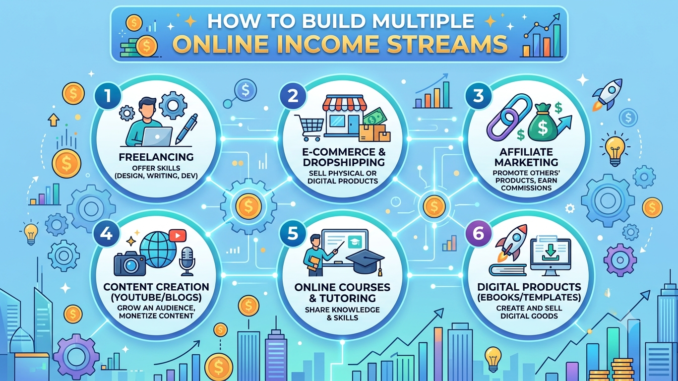
In today’s fast-changing digital economy, relying on a single source of income is one of the biggest financial risks you can take. Whether you are a full-time employee, a freelancer, or a student, creating multiple online income streams offers financial stability, independence, and the opportunity to build long-term wealth.
The internet has democratized wealth creation. You no longer need millions of dollars in capital or physical real estate to generate passive income. With a laptop, a stable internet connection, and dedication, you can build digital assets that earn money for you 24/7.
This article outlines a step-by-step framework to help you plan, build, and scale multiple online revenue streams effectively.
1. Understanding the Mindset: Active vs. Passive Income
Before diving into specific business models, it is essential to understand the two main categories of online income:
- Active Income: Money earned by directly trading your time for money (e.g., freelancing, consulting, virtual assistance). If you stop working, the income stops.
- Passive Income: Money generated from assets built or invested in upfront that continue to pay out over time with minimal ongoing effort (e.g., digital products, affiliate marketing, ad revenue).
The Golden Rule: Start with an active income stream to secure immediate cash flow, and then reinvest your earnings and spare time into building passive income streams.
2. Top Online Income Streams to Consider
To build a diversified portfolio, consider combining streams from different categories below:
A. High-Skill Services (Active Income)
- Freelancing: Offer specialized skills such as web development, graphic design, copywriting, or video editing on platforms like Upwork, Fiverr, or directly through LinkedIn.
- Consulting & Coaching: If you possess expertise in business, fitness, marketing, or career development, offer one-on-one strategy sessions.
B. Content Creation & Media (Semi-Passive Income)
- Blogging / Content Websites: Create a niche website around a specific topic (e.g., personal finance, technology, eco-friendly living). Monetize through display ads (Google AdSense, Mediavine) and sponsored content.
- YouTube Channel: Produce high-value video content. Once monetized, you earn through YouTube AdSense, brand sponsorships, and merchandise sales.
C. Digital Products (Passive Income)
- E-books & Guides: Write an in-depth guide addressing a specific problem in your niche and sell it via Amazon Kindle Direct Publishing (KDP) or Gumroad.
- Online Courses: Package your knowledge into a structured course and host it on platforms like Udemy, Teachable, or Skillshare.
- Digital Templates & Assets: Create Notion templates, Canva graphics, website themes, or stock photos and sell them repeatedly on Etsy or Creative Market.
D. Affiliate & E-Commerce Models (Passive to Semi-Passive)
- Affiliate Marketing: Recommend products or services you trust using unique referral links. Earn a commission every time someone purchases through your link (e.g., Amazon Associates, software affiliate programs).
- Print on Demand (POD): Design custom graphics for t-shirts, mugs, or notebooks. When a customer orders, a third-party company prints and ships the item for you (e.g., Printify, Redbubble).
3. Step-by-Step Roadmap to Building Your Streams
Trying to launch five income streams at once is a recipe for burnout. Follow this phased approach instead:
Step 1: Master One Core Skill First
Focus on building a single income stream until it is stable and profitable. For instance, spend 3–6 months establishing yourself as a freelance writer or launching a YouTube channel.
Step 2: Productize Your Expertise
Once you have mastered a service, turn it into a product:
- Freelance Writer $\rightarrow$ Write an E-book on copywriting.
- Web Developer $\rightarrow$ Build and sell website templates.
- Fitness Coach $\rightarrow$ Create a downloadable 12-week workout program.
Step 3: Reinvest into Passive Assets
Use the profit from your primary income source to fund passive ventures (e.g., hiring an editor for your blog, buying better equipment, or investing in digital tools).
Step 4: Automate and Delegate
As your streams grow, automate repetitive tasks using software tools (like Zapier, ConvertKit, or social media schedulers) or hire virtual assistants to manage daily operations.
4. Key Challenges & How to Avoid Them
| Challenge | Cause | Solution |
| Shiny Object Syndrome | Jumping between different business ideas without finishing any. | Stick to one stream until it generates consistent income. |
| Burnout | Working 80 hours a week trying to manage multiple manual tasks. | Prioritize passive/digital assets and automate systems early. |
| Lack of Traffic | Creating great products that nobody knows about. | Master basic SEO, social media marketing, or email list building. |
5. Summary Matrix: Diversifying Your Income Portfolio
Here is a simple blueprint for a balanced 3-tier online portfolio:
[ Tier 1: Active Cash Flow ]  -->  Freelancing / Consulting
          │
          ▼
[ Tier 2: Digital Products ]  -->  E-books, Templates, Courses
          │
          ▼
[ Tier 3: Passive Media ]     -->  Affiliate Marketing, Ad Revenue
Final Thoughts
Building multiple online income streams is not a “get-rich-quick” strategy; it is a long-term strategy for building digital real estate. By taking systematic steps—mastering one stream, packaging your knowledge, and reinvesting your earnings—you can create a resilient, scalable online ecosystem that generates income even while you sleep. Start small today, stay consistent, and let compound growth do the rest.
Leave a Reply