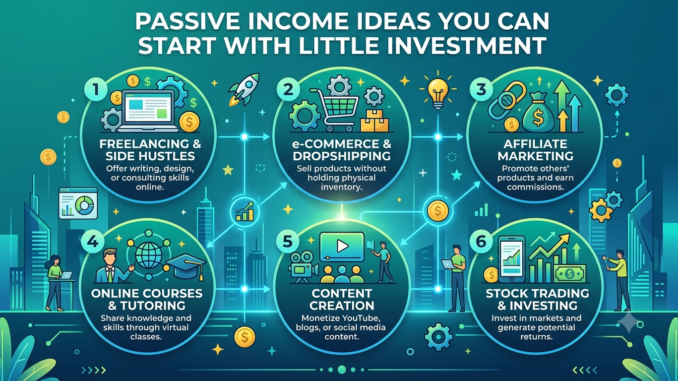
The concept of making money while you sleep has transformed from a pipe dream into a realistic financial goal for millions of people worldwide. Traditional financial advice often preaches working hard, saving diligent portions of a monthly salary, and waiting decades to enjoy the fruits of your labor. While discipline remains essential, the digital economy and modern business models have unlocked a new path: Passive Income.
Passive income refers to earnings derived from an enterprise, project, or asset that requires minimal day-to-day effort to maintain once the initial foundation is established. Notice the keyword: initial foundation. Passive income is rarely “free money”—it almost always demands an upfront investment of either capital or sweat equity (time and effort).
If you don’t have thousands of dollars sitting in a brokerage account to yield high-dividend returns right away, don’t worry. This article explores practical, highly scalable passive income streams you can start today with little to no upfront financial investment.
Understanding the Passive Income Spectrum
Before diving into specific ideas, it is crucial to understand that passive income exists on a spectrum.
| Income Type | Initial Investment | Maintenance Required | Time to Profit |
| High Capital (e.g., Real Estate, Stocks) | $1,000 – $100,000+ | Low | Instant to Medium |
| High Sweat Equity (e.g., Digital Products, Blogging) | $0 – $100 | Medium initially, then Low | Medium to Long-term |
When starting with a small budget (under $100–$200), your primary leverage is your time, existing skills, and creativity. You build an asset once, and that asset continues to generate cash flow over time.
1. Digital Products: Create Once, Sell Forever
Selling digital items is arguably the purest form of digital passive income with low startup costs. Unlike physical goods, digital products carry zero inventory costs, no shipping fees, and infinite scalability.
A. Printables and Digital Planners
- The Concept: Create downloadable PDFs, budget trackers, wall art, habit trackers, or digital planner templates for apps like GoodNotes or Notion.
- How to Start: Use free graphic design tools like Canva or Inkscape to design your templates.
- Selling Platforms: Open a shop on Etsy, Gumroad, or Payhip.
- Startup Cost: Nearly $0 (Etsy charges a nominal $0.20 listing fee per item).
- Passive Nature: Once designed and listed, the platform handles automatic delivery every time a customer purchases your file.
B. E-books and Micro-Guides
- The Concept: Write an e-book solving a specific problem or teaching a skill you already possess (e.g., “Beginner’s Guide to Meal Prepping on a Budget” or “How to Code in Python in 30 Days”).
- How to Start: Write your manuscript on Google Docs or Microsoft Word. Convert it to PDF or EPUB format.
- Selling Platforms: Amazon Kindle Direct Publishing (KDP) lets you publish for free and reach millions of global readers.
- Pro-Tip: Focus on evergreen topics—topics that remain relevant over many years—so your book continues selling without constant revisions.
2. Content Monetization & Digital Assets
Building an online audience takes time, but once established, content can generate recurring passive income through ad networks, sponsorships, and affiliate links.
A. Blogging & Niche Websites
- The Concept: Build a website dedicated to a specific niche (e.g., home gardening, pet care, coffee brewing, tech reviews).
- How to Start: Register a domain name and buy basic web hosting (costs around $3 to $5 per month using providers like Hostinger or Bluehost). Install WordPress and start writing helpful, SEO-optimized articles.
- Monetization:
- Display Ads: Join networks like Google AdSense, Ezoic, or Mediavine to earn money whenever visitors view or click ads on your site.
- Affiliate Marketing: Recommend products and include tracking links. If a reader purchases through your link, you earn a percentage commission.
- Passive Nature: An article written today can drive organic traffic from search engines (like Google) and make ad money for years to come.
B. YouTube Channel (Faceless Content)
- The Concept: You don’t need to show your face on camera to build a successful YouTube channel. “Faceless” channels focusing on study music, ambient noise, video essays, stock footage tutorials, or animated summaries thrive on the platform.
- How to Start: Use free video editors like CapCut or DaVinci Resolve, combined with royalty-free stock videos (Pexels, Pixabay) and voiceovers.
- Monetization: YouTube Partner Program (Ad revenue), channel memberships, and affiliate links in video descriptions.
3. Print-on-Demand (POD) Merchandising
Print-on-demand allows you to sell custom merchandise without holding inventory, buying printing machinery, or handling shipping.
How Print-on-Demand Works:
- You design a graphic or slogan (using Canva, Photoshop, or GIMP).
- You upload the design onto a POD platform (like Printify, Printful, or Redbubble) and apply it to mockups of t-shirts, mugs, tote bags, phone cases, or hoodies.
- You list the item in your store.
- When a customer buys a $30 t-shirt, the POD supplier prints the shirt, ships it directly to the customer, and charges you the production cost (e.g., $15).
- You keep the profit margin ($15) automatically.
Why It Works for Beginners:
- Zero Inventory Risk: You never pay for physical inventory upfront.
- Automated Fulfillment: The printing partner handles manufacturing, packaging, and logistics completely hands-off.
4. Affiliate Marketing via Niche Social Accounts
Affiliate marketing is simply referring someone to a product or service online, and earning a referral fee when they buy. While blogging is one way to do this, leveraging social media is faster and cheaper.
Strategies to Consider:
- Curated Pinterest Boards: Create aesthetic boards (e.g., “Minimalist Home Decor”) and pin product images integrated with affiliate links (Amazon Associates, ShopStyle, or Collective Voice).
- TikTok / Instagram Reels Curations: Create short-form videos reviewing useful Amazon gadgets, tech gear, or fashion items. Place your link-in-bio (using tools like Linktree or Beacons) directing viewers to your affiliate storefront.
Key Rule of Affiliate Marketing: Always disclose affiliate links transparently to maintain trust with your audience and follow regulatory guidelines (such as legal disclosure laws).
5. Stock Photography, Graphics, and Audio
If you have a knack for photography, digital illustration, graphic design, or music production, your creative portfolio can serve as a passive engine.
Opportunities Available:
- Stock Photos & Footage: Upload high-quality, high-demand photos (business meetings, lifestyle shots, nature, tech) to stock marketplaces like Shutterstock, Adobe Stock, or iStock.
- Graphic Vectors & Icons: Design iconography sets, background patterns, or vector illustrations and sell them on Creative Market or Freepik.
- Audio Beats & SFX: Sound designers can upload royalty-free music loops, intro jingles, or sound effects to platforms like AudioJungle or Pond5.
Every time a creator, marketer, or company licenses your asset for their project, you receive a royalty payout.
6. Micro-Investing & Dividend Reinvestment
For those who want purely financial passive income without creating content or products, low-barrier stock market investing is the way to go. You do not need thousands of dollars; micro-investing apps allow you to start with as little as $5 to $10.
A. Dividend-Paying ETFs & Index Funds
- The Concept: Buying shares in dividend-paying Exchange-Traded Funds (ETFs) or broad market index funds (like S&P 500 index funds) grants you a share of company profits paid out quarterly or annually.
- Strategy: Set up DRIP (Dividend Reinvestment Plan). Instead of taking the cash payout, your dividends are automatically reinvested to purchase more fractional shares. Over time, this triggers exponential compound growth.
B. Micro-Investing Apps
Platforms like Acorns, Robinhood, or M1 Finance allow users to invest spare change by rounding up everyday debit card purchases or making small, automated weekly contributions.
7. Licensing & Selling Online Courses
If you have specialized knowledge—whether in programming, digital marketing, cooking, language learning, or playing an instrument—you can turn that knowledge into a scalable asset.
How to Build a Course on a Budget:
- Outline the Curriculum: Break your topic down into digestible, step-by-step modules.
- Record the Lessons: Use a smartphone camera or free screen-recording software (like OBS Studio) to record your presentations.
- Host the Course: Upload your course to marketplace platforms like Udemy or Skillshare.
- Why Platforms Win: Udemy and Skillshare already have tens of millions of active students searching for courses. They handle payment processing, video hosting, and student dashboards for free in exchange for a revenue share.
Step-by-Step Action Plan to Get Started
Trying to launch five passive income streams at once is a recipe for burn-out. Success requires focus, consistency, and realistic expectations. Follow this 4-step framework to launch your first stream:
[ Step 1: Audit Resources ] ──► [ Step 2: Choose ONE Idea ] ──► [ Step 3: Build & Launch ] ──► [ Step 4: Automate & Scale ]
Step 1: Audit Your Capital vs. Time
Be honest about what you possess.
- Do you have more time than money? Choose digital products, blogging, print-on-demand, or YouTube.
- Do you have small sums of spare cash ($50–$100/month) and limited time? Focus on dividend micro-investing.
Step 2: Select One Idea and Commit for 6 Months
Resist “shiny object syndrome.” Commit to building one passive income asset for at least 6 months before judging its financial success. Most passive streams require a period of unpaid effort before generating compounding returns.
Step 3: Focus on Quality and Problem Solving
Whether you are writing an e-book, designing a printable, or producing a YouTube video, focus on delivering genuine value. High-quality assets generate positive reviews, organic word-of-mouth, and higher search rankings—all of which drive ongoing passive sales.
Step 4: Automate and Reinvest
Once your asset generates initial cash flow:
- Automate repetitive processes using tools like Zapier, scheduling apps, or social media automation software.
- Reinvest your initial earnings into paid marketing, better equipment, or professional tools to grow the cash flow faster.
Common Pitfalls to Avoid
- Expecting “Get-Rich-Quick” Results: True passive income takes time to build. Beware of schemes that promise overnight riches for zero effort.
- Neglecting Upkeep Entirely: Purely passive streams are rare. Most assets require periodic maintenance, updates, customer support, or occasional promotional pushes to remain profitable long-term.
- Spreading Yourself Too Thin: Launching multiple half-finished projects will yield zero income. Finish one digital asset completely, launch it, and optimize it before moving to the next.
Conclusion
Starting a passive income journey does not require a huge bank account, an advanced business degree, or a team of employees. In today’s interconnected digital world, leverage has shifted toward creativity, knowledge, and consistency.
By starting small—whether creating simple digital planners on Canva, launching a print-on-demand store, or building a small dividend portfolio—you take the first tangible step toward financial flexibility. Choose one idea that aligns with your skills today, put in the upfront effort, and build assets that work for you around the clock.
Leave a Reply