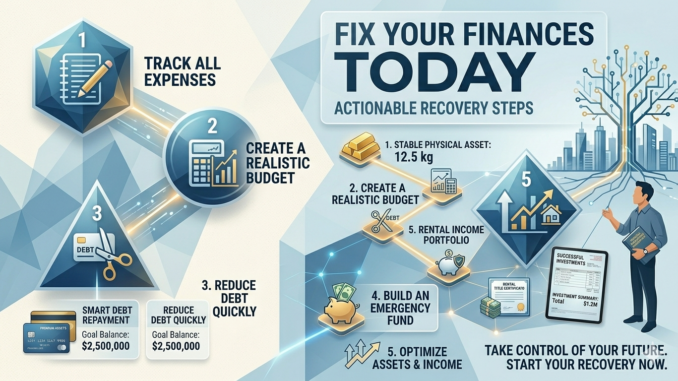
I remember the exact moment I realized my finances were a mess.
It wasn’t dramatic. No big crisis. Just a quiet moment—sitting alone, checking my balance, and feeling that familiar stress creeping in.
I kept telling myself:
“I’ll fix it later.”
But “later” never came.
If you’re being honest, you might be in a similar place right now. Not completely broke—but not in control either.
The good news? You don’t need a perfect plan to fix your finances.
You just need to start—today.
Step 1: Face the Reality (Even If It’s Uncomfortable)
This is where everything begins.
For a long time, I avoided looking at my numbers:
- Bank balance
- Expenses
- Debts
Not because I didn’t care—but because I didn’t want to feel overwhelmed.
But avoiding it didn’t make anything better. It just made things unclear.
The day I finally wrote everything down was the day things started changing.
Lesson: You can’t fix what you refuse to face.
Step 2: Cut the Silent Money Leaks
Once I started tracking my spending, I noticed something surprising.
It wasn’t the big expenses hurting me—it was the small, repeated ones:
- Daily food orders
- Subscriptions I forgot about
- Impulse purchases
Individually, they felt harmless. Together, they were draining me.
I didn’t cut everything. I just became more intentional.
Lesson: Small leaks sink big ships. Fix them first.
Step 3: Build a Simple System You Can Stick To
I used to think I needed a perfect budget.
Something detailed, structured, and flawless.
But every time I tried, I gave up within days.
What actually worked was something simple:
- Cover essential needs first
- Save a small portion consistently
- Spend the rest without guilt—but with awareness
It wasn’t perfect. But it was sustainable.
Lesson: A simple system you follow beats a perfect system you quit.
Step 4: Stop the Cycle of “Earn and Spend”
This was a pattern I didn’t notice at first.
I would:
- Earn money
- Feel relieved
- Spend more freely
Then suddenly, I was back where I started.
It felt like running in circles.
Breaking that cycle required one shift:
Just because you can spend doesn’t mean you should.
Once I started separating income from spending habits, things improved.
Lesson: If your lifestyle grows with your income, your wealth won’t.
Step 5: Start Saving—No Matter How Small
I used to wait for the “right time” to save.
A better income. Fewer expenses. More stability.
But that moment never came.
So I started small.
Very small.
At first, it felt pointless. But over time, it became a habit—and then a safety net.
Lesson: Saving is not about how much—it’s about starting.
Step 6: Take Control of Your Income
Fixing finances isn’t just about cutting back—it’s also about moving forward.
At some point, I realized:
I can’t just manage money better—I need to earn better too.
So I started exploring:
- New skills
- Side opportunities
- Ways to increase my value
It didn’t happen instantly. But it gave me momentum.
Lesson: Better income makes everything easier—but it starts with effort.
Step 7: Be Consistent, Not Perfect
This might be the most important lesson of all.
There were days I slipped:
- Overspent
- Ignored my plan
- Made poor decisions
Before, I would give up completely.
Now, I reset and continue.
Because consistency—not perfection—is what creates real change.
Lesson: Progress comes from showing up, even when you’re not perfect.
Experience Matters (E-E-A-T Perspective)
Everything I’ve shared here comes from personal experience.
I’ve:
- Avoided my finances when I shouldn’t have
- Made repeated money mistakes
- Felt stuck and unsure where to start
But I’ve also:
- Taken control step by step
- Built better habits over time
- Seen real improvement through consistency
This isn’t a perfect journey. It’s a real one.
And that’s what makes it work.
Final Thoughts
Fixing your finances doesn’t require a complete life overhaul.
It starts with small, honest steps:
- Facing your reality
- Making better choices
- Staying consistent
You don’t need to wait for the perfect moment.
Because the best time to fix your finances… is today.
Conclusion
At the end of the day, financial control is not about how much you earn—it’s about how you manage what you have.
You don’t need to be perfect. You just need to be intentional.
Start small. Stay consistent. Keep improving.
Because once you take control of your money,
you start taking control of your life.
Leave a Reply