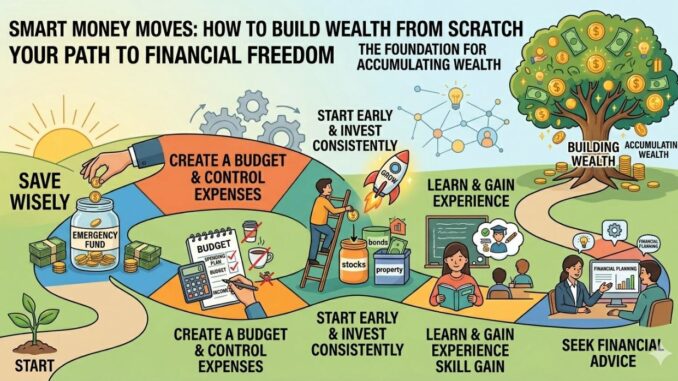
We’ve all seen those “get rich quick” ads—the ones featuring 20-somethings standing in front of rented Ferraris. But let’s be real: for most of us, wealth isn’t built overnight. It’s built in the quiet moments, the disciplined choices, and the boring-but-effective habits we practice every day.
When I started my financial journey, my bank account was more “empty” than “investment-ready.” I didn’t have a trust fund or a high-six-figure salary. I just had a burning desire to stop living paycheck to paycheck.
If you’re starting from scratch, here is the roadmap I used (and still use) to turn financial stress into financial freedom.
1. The Mindset Shift: Wealth is What You Don’t See
In my early 20s, I thought being wealthy meant having the latest iPhone and eating out every night. I was wrong. Wealth is the money you keep, not the money you spend. The first “smart move” I ever made wasn’t buying a stock; it was realizing that looking rich and being wealthy are often opposites. Once I stopped trying to impress people who didn’t care about my future, I finally had the breathing room to actually save.
2. Kill the “Silent Killers” (High-Interest Debt)
You cannot build a skyscraper on a foundation of quicksand. High-interest debt—specifically credit cards—is financial quicksand.
- My Experience: I used the “Debt Snowball” method. I paid off my smallest debts first to get the psychological win. Seeing a balance hit zero gave me the momentum to tackle the bigger ones.
- The Math: If you are paying 20% interest on a credit card while earning 7% in the stock market, you are still losing money. Kill the debt first.
3. The Power of “Automated” Consistency
I used to tell myself, “I’ll invest whatever is left at the end of the month.” Guess what? There was never anything left.
The game-changer for me was paying myself first. I set up an automatic transfer of just 10% of my income to a separate savings/investment account the day I got paid.
Pro-Tip: If you don’t see the money in your checking account, you won’t miss it. Automation removes the “discipline” factor and makes wealth-building a default setting.
4. Investing in the “S&P 500” vs. Picking Winners
When I first started, I tried to pick the “next big stock.” I lost money. I realized that as a regular person with a job, I don’t have the time to analyze balance sheets all day.
Instead, I shifted to Low-Cost Index Funds. By investing in the top 500 companies in the US (the S&P 500), I let the world’s best CEOs work for me. It’s not flashy, but historically, it’s one of the most reliable ways to build long-term wealth.
My Personal Lessons (E-E-A-T Insights)
From my years of managing my own finances and advising peers, here is the “human” truth about money:
- Your Income is your Greatest Wealth-Building Tool: Don’t just focus on cutting lattes; focus on increasing your value. Learn a new skill, ask for that raise, or start a side hustle.
- Emergency Funds are for Sanity, not just Repairs: Having 3–6 months of expenses in a high-yield savings account changed my life. Not because of the interest, but because I stopped making “desperate” career choices. I could say “no” to bad jobs because I had a cushion.
- Time is more valuable than Timing: Don’t wait for the “perfect” market. The best time to start was ten years ago; the second best time is today.
Final Thoughts
Building wealth from scratch isn’t about a single “lucky break.” It’s about the cumulative power of small, smart decisions. It’s about choosing your future self over your current impulses.
If you feel overwhelmed, just start with one move: Track your spending for 30 days. You can’t manage what you don’t measure. Once you see where your money is “leaking,” you can start plugging the holes and redirecting that flow toward your dreams.
Conclusion
At the end of the day, money is just a tool. It’s a tool that provides you with options, security, and the ability to help others. You don’t need to be a math genius to build wealth; you just need to be consistent, patient, and willing to learn from your mistakes.
Leave a Reply