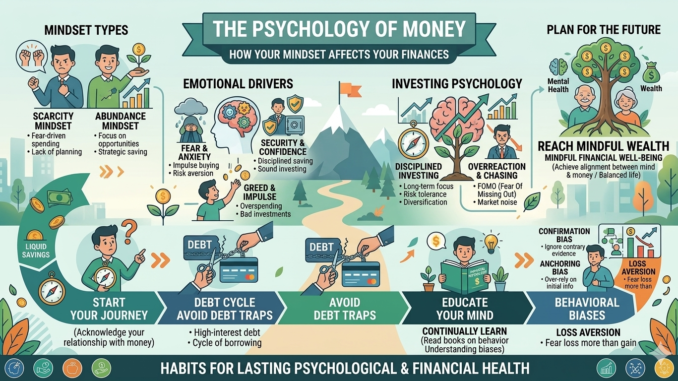
When people talk about money, they usually focus on numbers—income, expenses, savings, investments. But from my personal experience, money is rarely just about numbers. It’s about behavior. It’s about emotions. And most importantly, it’s about mindset.
There was a time when I believed that if I just earned more, all my financial problems would disappear. But even as my income slowly increased, I noticed something frustrating—I wasn’t making real progress. I was still saving inconsistently, still spending impulsively at times, and still feeling uncertain about my financial future.
That’s when I started to realize something deeper: the way I think about money was shaping every financial decision I made.
Understanding the psychology of money changed everything for me. Not instantly, but gradually. It helped me become more aware of my habits, my emotional triggers, and the invisible patterns that were holding me back.
This article isn’t based on theory alone—it comes from real-life experience, reflection, and learning the hard way. If you want to improve your financial life, you don’t just need better strategies. You need a better relationship with money.
Your Financial Behavior Is Emotional, Not Logical
One of the biggest lessons I’ve learned is that most financial decisions are not purely logical.
We like to think we make rational choices—comparing prices, planning budgets, thinking long-term. But in reality, emotions often play a bigger role than we realize.
For example:
- Buying something because it feels rewarding after a stressful day
- Avoiding checking your bank account because it creates anxiety
- Spending to fit in socially or to feel successful
I’ve done all of these at different points in my life. And the problem is, these decisions feel justified in the moment—but they often lead to regret later.
Once I became aware of this, I started pausing before making financial decisions. Not every time, but more often. And that small pause made a big difference.
Your Money Habits Come From Your Past
Whether we realize it or not, our financial mindset is shaped by our upbringing, environment, and early experiences.
Growing up, I didn’t have much exposure to financial education. Money was something you earned, spent, and worried about—but rarely discussed in a structured way.
Because of that, I developed habits without understanding them:
- Saving inconsistently
- Avoiding long-term planning
- Feeling uncertain about financial decisions
It wasn’t until I started reflecting on these patterns that I could begin to change them.
Understanding where your habits come from doesn’t mean blaming the past—it means learning from it.
The Fear of Losing Money Is Real
One of the most powerful psychological factors in finance is fear.
I remember hesitating to invest for a long time—not because I didn’t want to grow my money, but because I was afraid of losing it.
That fear is natural. No one likes losing money. But avoiding all risk can also limit growth.
Over time, I learned that managing fear is part of financial growth:
- Start small
- Learn as you go
- Accept that not every decision will be perfect
Confidence doesn’t come from avoiding risk—it comes from understanding it.
Instant Gratification vs Long-Term Thinking
We live in a world where everything is fast—fast purchases, fast rewards, fast results.
And that mindset can easily affect how we handle money.
There were times when I chose immediate comfort over long-term benefit:
- Spending instead of saving
- Delaying investments
- Choosing short-term enjoyment over long-term stability
It didn’t feel like a big deal at the time. But over months and years, those small decisions added up.
Developing a long-term mindset doesn’t mean you can’t enjoy life—it just means you’re aware of the trade-offs.
Comparison Can Destroy Your Financial Confidence
One of the most harmful habits I had was comparing my financial situation to others.
Seeing friends or people online living a more “comfortable” lifestyle made me feel like I was behind. And sometimes, that feeling led to unnecessary spending—just to keep up.
But here’s what I’ve learned:
You don’t see the full picture of someone else’s finances. You don’t see their debt, their stress, or their long-term plans.
Once I stopped comparing and focused on my own journey, I felt more in control—and made better decisions.
Small Habits Reflect Your True Mindset
Your mindset isn’t just what you think—it’s what you do consistently.
For me, it showed up in small daily habits:
- Whether I tracked my expenses
- Whether I saved regularly
- Whether I thought before spending
These habits might seem minor, but they reflect your relationship with money.
Changing your mindset doesn’t happen overnight. It happens through repeated actions.
Financial Confidence Comes From Clarity
There was a time when I felt uncertain about my finances—not because things were terrible, but because I didn’t have clarity.
Once I started:
- Tracking my income and expenses
- Setting simple goals
- Reviewing my progress regularly
I felt more confident—not because I was rich, but because I understood my situation.
Clarity reduces stress. And less stress leads to better decisions.
You Don’t Need to Be Perfect
One of the biggest mental barriers I faced was the idea that I needed to get everything “right.”
But the truth is, nobody manages money perfectly.
I’ve made mistakes—overspending, delaying savings, making poor decisions. But each mistake taught me something.
What matters is not perfection, but progress.
Final Thoughts
Understanding the psychology of money is not about changing everything at once—it’s about becoming more aware of how you think, feel, and behave around money.
From my own journey, I can say this: the biggest changes didn’t come from earning more or finding the perfect strategy. They came from small shifts in mindset.
When you start paying attention to your habits, your emotions, and your decisions, you begin to take control.
And that control is more powerful than any financial shortcut.
Conclusion
Your financial life is deeply connected to your mindset.
It’s not just about how much you earn—it’s about how you think, how you decide, and how you act consistently over time.
The good news is that mindset can change.
With awareness, patience, and small daily improvements, you can build a healthier relationship with money—and a more stable financial future.
Because in the end, mastering your finances starts with mastering your mind.
Leave a Reply